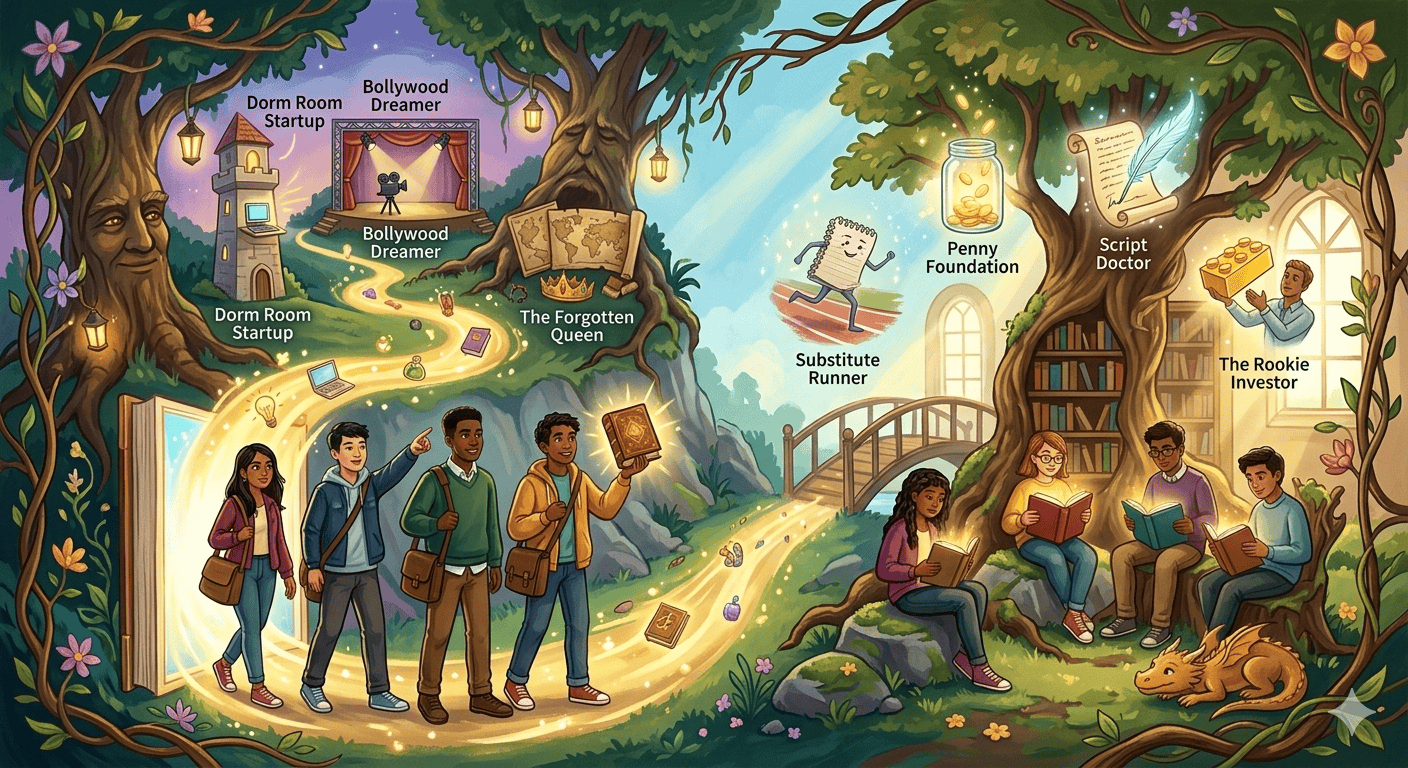
Motivational stories for students act as a powerful catalyst for personal growth and academic perseverance.
These narratives provide the necessary spark to transform academic challenges into stepping stones toward future success.
By engaging with relatable tales of triumph over adversity, learners can develop the resilience needed to excel in their studies and beyond.
Exploring motivational stories for students helps cultivate a mindset focused on continuous improvement and unwavering determination.
Read through our inspiring collection now to find the encouragement you need to reach your highest potential!
Table of Contents
1. The Startup in the Dorm Room
A determined student named Alex spent his nights hunched over a laptop, ignoring the parties echoing down the hallway of his dormitory.
While his peers focused on immediate social rewards, Alex was obsessed with a glitchy piece of software he believed could simplify grocery deliveries for the elderly.
His initial version crashed repeatedly, and his roommates often joked that he was wasting the best years of his life on a “delivery app that doesn’t deliver.”
Instead of being discouraged, Alex treated every bug as a lesson, refining the code based on direct feedback from the few neighbors who actually used it.
He prioritized the mechanical necessity of solving a problem over the vanity of looking successful, eventually attracting the attention of a local angel investor.
By the time graduation arrived, Alex wasn’t just a student; he was the CEO of a company that employed half of his graduating class.
Learning: True success is built on the foundation of solving real problems for others rather than chasing personal prestige.
Reference: This story reflects the origins of Michael Dell, who started his multibillion-dollar computer company in a dorm room at the University of Texas.
2. The Substitute Runner
Leo was the perennial “benchwarmer” of the varsity track team, always the first to carry the water bottles and the last to get a jersey.
He lacked the natural explosive speed of the star runners, but he possessed a quiet, iron-clad discipline that no one else noticed.
Every evening, long after the official practice had ended and the stadium lights were dimmed, Leo returned to the track to run intervals in the dark.
He recorded his times in a tattered notebook, competing only against the ghost of his previous day’s performance.
When the championship race arrived, a sudden flu sidelined the team’s fastest sprinter, and the coach had no choice but to put Leo on the starting block.
As the gun fired, the crowd expected Leo to fall behind, but his months of secret, grueling labor had built a reservoir of stamina his rivals lacked.
Learning: Discipline is what you do when no one is watching, and preparation is the only bridge between opportunity and victory.
Reference: This mirrors the story of Tom Brady, who was a low-ranked draft pick and backup before his tireless preparation made him a legend.
3. The Forgotten Queen
In the dusty corners of a colonial archive, a student named Meera discovered the fragmented records of a queen who had been erased from official history books.
While her classmates wrote papers on well-known kings, Meera spent months cross-referencing ancient trade ledgers and private letters to reconstruct the queen’s strategic brilliance.
This forgotten ruler hadn’t won through brute force, but through a radical emphasis on literacy and diplomatic patience that kept her borders peaceful for decades.
Meera faced skepticism from her professors, who felt the research was a dead end because the “important” history had already been written.
Meera persisted, driven by the belief that truth is more valuable than consensus, eventually publishing a thesis that forced a rewrite of the regional curriculum.
Learning: Persistence in seeking the truth can dismantle long-standing misconceptions and create a legacy that honors those who came before us.
Reference: This draws from the life of Hatshepsut, a powerful female Pharaoh whose legacy was intentionally erased for centuries until historians rediscovered her.
4. The Bollywood Dreamer
Priya arrived in Mumbai with a single suitcase and a script that everyone told her was “too intellectual” for a commercial audience.
She spent her first year working as an assistant to an assistant, brewing tea and organizing schedules for directors who didn’t even know her name.
Between shifts, she stood at the back of movie sets, silently absorbing the technical nuances of lighting, framing, and pacing.
She faced dozens of rejections from producers who wanted her to change the soul of her story to fit a tired, predictable formula.
Instead of yielding, Priya saved every rupee to film a short pilot of her script using a borrowed camera and her friends as actors.
That small, raw piece of film captured a level of authentic emotion that the big-budget productions lacked, eventually going viral and sparking a bidding war.
Learning: Authenticity and a deep understanding of your craft will eventually resonate more powerfully than any trend or expensive artifice.
Reference: Inspired by the grit of filmmakers like Zoya Akhtar, who worked her way up through the industry to tell unique, character-driven stories.
5. The Penny Foundation
Sam was only ten years old when he noticed a classmate skipping lunch because his family couldn’t afford the cafeteria fees.
Troubled by this, Sam decided to start a collection jar in his classroom, asking for nothing more than a single penny from anyone who could spare it.
Many adults laughed at the idea, claiming that “pennies can’t buy a sandwich,” let alone solve the problem of school hunger.
Undeterred, Sam spent his weekends explaining his mission to local shopkeepers, eventually placing his “Penny Jars” across the entire town.
Within six months, the mountain of copper coins had grown into thousands of dollars, enough to clear the lunch debt for every student in the district.
The small project evolved into a registered charity that now partners with major food banks to provide meals annually.
Learning: No act of kindness is too small to make a difference, and the collective power of small contributions can move mountains.
Reference: Based on the Penny Harvest, a youth-led philanthropic movement that turned small change into millions of dollars for community grants.
6. The Hollywood Extra
For a decade, Elias was the face in the background of every major action movie, the unnamed pedestrian or the silent waiter in a crowded restaurant.
He studied his lines for roles he never got and maintained a professional attitude even when he was treated as part of the scenery.
One afternoon, during the filming of a courtroom drama, the lead actor struggled to find the right emotional tone for a pivotal scene.
Seeing an opportunity, Elias, playing a court clerk, offered a subtle, improvised reaction that perfectly mirrored the tension of the moment.
The director stopped the cameras and asked Elias to repeat the movement, which led to a speaking line, then a supporting role, and finally his own starring vehicle.
Learning: Success is often the result of being exceptionally prepared for a very brief window of opportunity that may only open once.
Reference: This is the story of many “character actors” like Gene Hackman, who worked in obscurity for years before reaching stardom through consistent excellence.
7. The Reluctant Entrepreneur
David failed his “Intro to Business” course twice, struggling to memorize the abstract formulas presented in his textbooks.
His professor told him he didn’t have the “analytical mind” required for the corporate world, leaving David feeling like a failure.
However, David noticed a recurring problem in his own neighborhood: local farmers were losing half their crop because they lacked a way to get fresh produce to city markets.
Using the “failure” of his academic career as motivation, David spent months on the ground, talking to drivers and farmers to understand the logistical bottlenecks.
He designed a lean, technology-driven distribution model that cut out the middlemen and doubled the farmers’ profits.
When he finally launched his startup, it became a massive success because it was built on lived experience rather than academic theory.
Learning: Academic grades do not define your potential; your ability to observe the world and solve its practical problems is the true measure of your value.
Reference: This mirrors the story of Jan Koum, the co-founder of WhatsApp, who struggled in traditional school environments before creating a global communication tool.
8. The Library Ghost
Sarah was known as the “Library Ghost” because she spent every waking hour in the university’s basement archives, surrounded by crumbling ledgers and faded maps.
Her peers were out building networks, while Sarah was obsessed with a series of 19th-century shipping logs that seemed to contain a mathematical anomaly.
She was looking for a pattern that everyone else insisted was just a series of clerical errors made by bored sailors over a hundred years ago.
After three years of meticulous analysis, Sarah proved that the “errors” were actually an undocumented recording of shifts in ocean currents.
Her discovery provided the missing link for modern climate scientists trying to model long-term environmental changes.
Sarah’s work, initially dismissed as a hobby, became the foundation for a global initiative to protect coastal cities.
Learning: Profound breakthroughs often require the kind of deep, solitary focus that the rest of the world might mistake for insignificance.
Reference: Inspired by historical researchers like Alice Ball, whose quiet laboratory work led to the first effective treatment for leprosy.
9. The Comeback Season
Marcus was the star point guard whose future in the professional leagues seemed guaranteed until a ligament tear changed everything.
The surgery was successful, but the physical therapy was a grueling, slow process that left him far behind his teammates in terms of speed.
Instead of succumbing to bitterness, he shifted his focus to the mental side of the game, studying film for hours to understand his opponents’ psychological weaknesses.
When he finally returned to the court, he wasn’t as fast as he used to be, but he was twice as smart.
He led his team to a championship not by outrunning the competition, but by outthinking them at every turn.
Marcus proved that a setback is not the end of the road, but a chance to rebuild yourself into something even more formidable.
Learning: Resilience isn’t just about getting back to where you were; it’s about using hardships to develop new strengths you never knew you needed.
Reference: Reflects the career of Shaun Livingston, who overcame a devastating knee injury to become a key player in multiple NBA championships.
10. The Short Story Spark
Javier wrote short stories that were consistently rejected by every literary magazine he submitted to, often with notes saying his style was “too strange.”
He had a pile of over fifty stories that sat in a digital folder, representing years of work that no one seemed to want to read.
One evening, feeling defeated, he decided to post his shortest, strangest story on a public forum just to clear his head.
To his surprise, the story resonated with thousands of people who felt the same “strangeness” in their own lives.
Within a week, the story had been translated into five languages and shared by a famous author who called it a masterpiece.
The very magazines that had rejected him were now calling his agent, begging for his next piece of work.
Learning: Don’t let rejection silence your unique voice; sometimes the world just needs a little extra time to catch up to your perspective.
Reference: This is similar to the journey of Andy Weir, who published The Martian as a free serial online after failing to find a traditional publisher.
11. The Infinite Novel
Julian was a single father working two jobs who only had fifteen minutes during his bus ride and ten minutes before he fell asleep to write.
For three years, Julian wrote exactly one page every single night, no matter how exhausted he felt or how much he doubted the quality of his prose.
There were months when the story felt disjointed, but he refused to break the chain of his daily commitment.
When he finally typed the words “The End,” he realized he had written over 1,000 pages of a rich, complex epic.
His novel went on to become a bestseller, not because he was the most talented writer, but because he was the most consistent.
He proved that the “perfect time” to follow your passion doesn’t exist; you have to steal the time from the edges of your life.
Learning: Great achievements are rarely the result of grand gestures; they are the sum of small, unremarkable efforts repeated over time.
Reference: Inspired by authors like Toni Morrison, who wrote her first novel in the early morning hours while working as a full-time editor and mother.
12. The Ethical Pivot
Clara was a high-flying executive at a global finance firm, known for her ability to maximize profits and navigate the complexities of international markets.
Despite her prestigious title, she felt a sense of emptiness as she realized her work was primarily making wealthy people even wealthier.
After visiting a remote region where the lack of clean water prevented children from attending school, Clara decided she could no longer ignore her conscience.
She resigned from her position and used her expertise to build a social enterprise that funded water filtration systems through sustainable micro-loans.
She applied the same “cutthroat” efficiency she had learned in banking to the mission of saving lives, proving that business skills are a powerful tool for good.
Clara found a level of fulfillment her corporate bonuses could never provide, showing that success is hollow if it doesn’t align with your values.
Learning: True professional success is found at the intersection of your highest skills and your deepest sense of social responsibility.
Reference: Reflects the life of Muhammad Yunus, who left a traditional economics career to found Grameen Bank and pioneer micro-finance for the poor.
13. The Script Doctor
In the fast-paced world of Hollywood, Maya was a “Script Doctor,” a writer who is hired to fix broken movies but whose name never appears in the credits.
She worked on some of the biggest blockbusters of the decade, repairing plot holes and sharpening dialogue that others had bungled.
Although she was invisible to the public, she was the most respected figure among the industry’s elite because she cared more about the quality of the story than the glory of the byline.
One year, a film she had essentially rewritten won a major award, and while someone else accepted the trophy, Maya felt a quiet, profound sense of pride.
She knew that her work was the invisible skeleton that held the masterpiece together.
Maya’s career taught her that influence is often more powerful when it is quiet, and that being indispensable is better than being famous.
Learning: You don’t need public recognition to be a person of immense value; the quality of your work is its own reward.
Reference: Based on the career of Carrie Fisher, who was one of the most prolific and sought-after script doctors in Hollywood history.
14. The Rookie Investor
Tariq was an eighteen-year-old who spent his summer mowing lawns to save up money his parents wanted him to put into a safe savings account.
Instead, Tariq became fascinated by a local startup that was developing a way to turn plastic waste into affordable building bricks.
He met with the founders and was so impressed by their grit that he decided to invest every penny of his savings into their vision.
For two years, it looked like he had thrown his money away as the company struggled to find its first customer.
Tariq didn’t panic; he spent his weekends helping the founders with their marketing and volunteering to test the bricks.
Eventually, a major construction firm signed a contract, and Tariq’s small investment turned into a fortune that funded his entire education.
He learned that investing isn’t just about moving numbers; it’s about believing in people.
Learning: Wealth is a byproduct of investing in innovation and people you believe in, rather than just chasing safe or easy returns.
Reference: Mirrors the story of Peter Thiel, who made an early, risky investment in Facebook when it was just a small college project.
15. The Silent Philanthropist
Mrs. Gable was a retired schoolteacher who lived in a small, weathered house and drove a car that was twenty years old.
The townspeople often felt sorry for her, assuming she was struggling to get by on a meager pension and a life of solitude.
When she passed away at the age of ninety, the entire community was stunned to learn that she had left a five-million-dollar endowment to the local university.
It turned out that Mrs. Gable had lived a life of extreme frugality so that she could quietly invest her savings into a scholarship fund for underprivileged students.
She had spent decades watching “her kids” graduate and go on to become successful, never once telling them who was paying their tuition.
Her life was a masterclass in the power of an invisible legacy, showing that the greatest wealth is the kind you give away.
Learning: The ultimate success is not measured by what you accumulate for yourself, but by the opportunities you create for others.
Reference: Based on the real life of Osceola McCarty, a washerwoman who lived simply and donated her $150,000 life savings to fund scholarships.
Unlock your full academic potential by exploring these life-changing motivational stories for students and start building your path to success today!

Leave a Reply