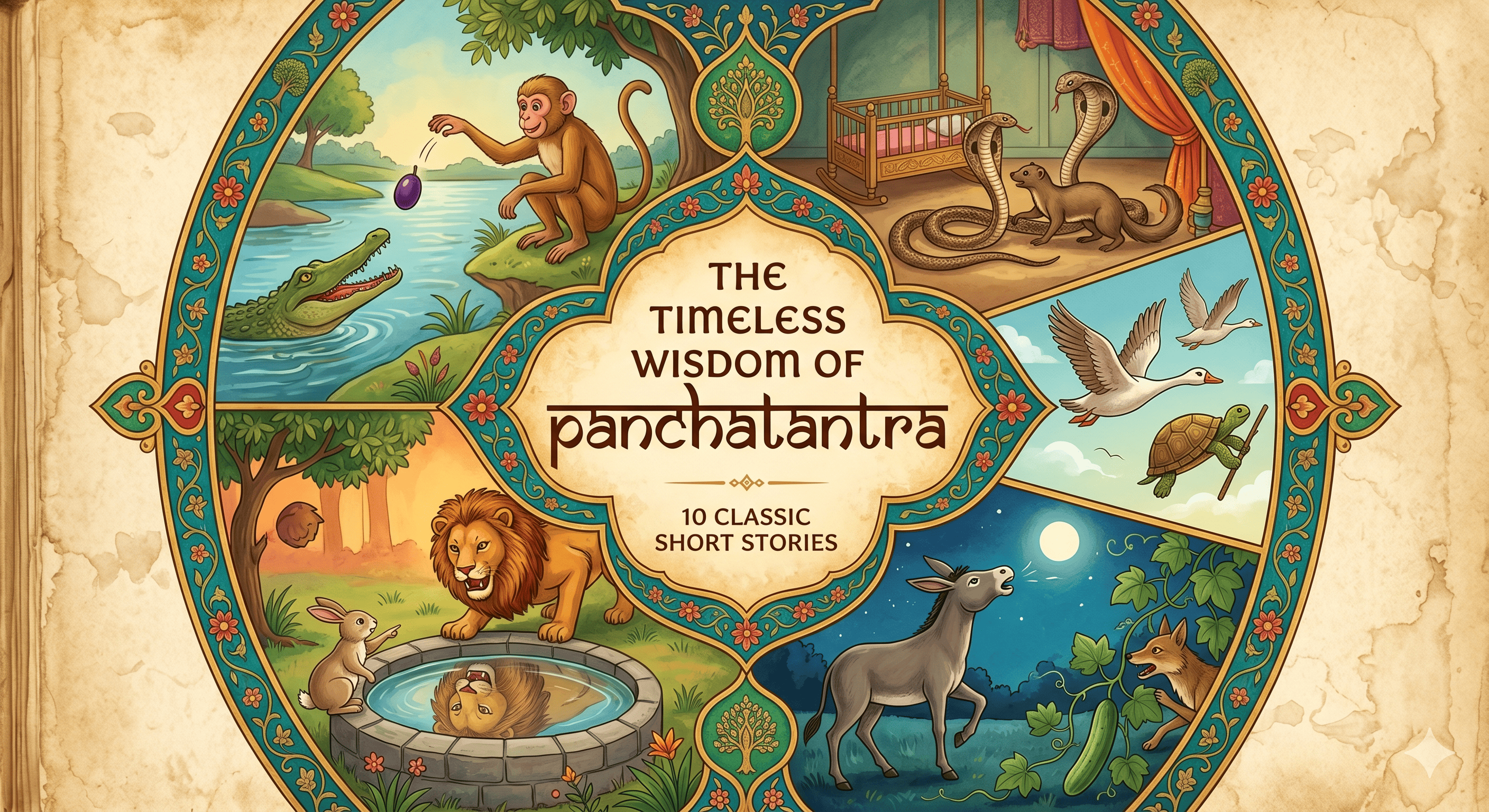
The short stories from Panchatantra represent an ancient Sanskrit masterpiece authored by Vishnu Sharma to teach “Niti,” the sophisticated art of wise conduct and political intelligence.
These fables serve as a strategic manual for navigating life’s complexities, offering profound psychological insights into friendship, leadership, and the mechanics of betrayal.
By exploring universal human traits such as greed and loyalty, these narratives provide a timeless moral framework that remains essential for both modern parenting and professional management.
Often recognized as the world’s original “management guide,” the collection utilizes high-stakes animal metaphors to sharpen problem-solving skills and strategic thinking.
As a cornerstone of global literature, the short stories of Panchatantra have left a permanent cultural legacy, directly influencing famous works like Aesop’s Fables and the Arabian Nights.
The Monkey and the Crocodile
A clever monkey lived on a magnificent jamun tree that overhung the sparkling waters of a river.
He spent his days eating the sweet, purple fruit and eventually befriended a crocodile who frequented the riverbank.
The monkey would toss handfuls of the ripe fruit down to the crocodile, who appreciated the kindness.
One day, the crocodile’s wife grew curious and demanded the monkey’s heart, believing it must be as sweet as the jamun.
The crocodile tricked the monkey onto his back, but confessed his plan in the middle of the river.
The monkey calmly claimed his heart was left on the tree and convinced the crocodile to return to the shore.
Upon reaching land, the monkey escaped, proving that presence of mind is the best weapon against betrayal.
The Learning: Never panic in a crisis; a clear mind can turn a predator’s strength into their weakness.
The Loyal Mongoose
A farmer and his wife raised a pet mongoose alongside their infant son, treating the animal with deep love.
One day, the mother left the baby alone with the mongoose while she went to the market.
A deadly cobra entered the room, and the mongoose fought a bloody battle to kill it and protect the child.
When the mother returned and saw the mongoose covered in blood, she assumed it had killed her son.
In a fit of blind rage, she killed the mongoose instantly, only to find her baby safe and the snake dead.
She realized her mistake too late, learning that actions taken in haste lead to a lifetime of regret.
The Learning: Observation must always precede execution; never let an emotional outburst dictate your actions.
The Tortoise and the Two Geese
A talkative tortoise named Kambugriva was forced to leave his drying lake with the help of two geese.
The plan was for the tortoise to hold a stick in his mouth while the geese flew him to a new pond.
The geese warned him that he must remain absolutely silent during the journey or he would fall.
As they flew over a village, people mocked the flying tortoise, causing him to grow indignant.
Unable to resist a comeback, he opened his mouth to insult them and plummeted to his death.
His fate reminds us that he who cannot control his tongue cannot control his destiny.
The Learning: Silence is a strategic asset; do not let the opinions of others provoke you into breaking your focus.
The Lion and the Clever Rabbit
Bhasuraka the lion was a tyrant who demanded one animal a day for his meal to stop his random killing.
When it was the rabbit’s turn, he arrived late and told the lion that a rival king had challenged him.
The rabbit led the arrogant lion to a deep well and pointed at the lion’s own reflection in the water.
Mistaking the reflection for a rival, the lion roared and jumped into the well, drowning instantly.
The tiny rabbit saved the forest, showing that intelligence is far more powerful than raw physical force.
The Learning: Use an opponent’s own ego and reflection against them; the strongest enemy is often the most easily blinded.
The Musical Donkey
A donkey and a jackal spent their nights feasting on vegetables in a farmer’s field under the moonlight.
One night, overwhelmed by the beauty of the field, the donkey felt a sudden urge to sing a “song.”
The jackal warned him that his braying would alert the farmers, but the donkey ignored him.
The donkey’s loud braying woke the farmers, who arrived with sticks and beat the donkey severely.
The jackal escaped, leaving the donkey to learn that there is a time and a place for everything.
The Learning: Talent or joy expressed at the wrong time is a liability, not an asset.
The Blue Jackal
A jackal accidentally fell into a dyer’s vat and turned a brilliant, divine-looking shade of blue.
He returned to the forest and claimed the heavens had appointed him king of all the animals.
Even the lions and tigers bowed to him, until one night a pack of jackals began to howl in the distance.
Compelled by his nature, the blue jackal howled back, revealing his true identity to the predators.
He was immediately chased away, proving that no amount of disguise can hide one’s true character forever.
The Learning: Authenticity is sustainable; artificial status will always collapse under the weight of instinct.
The Three Fish
Three fish—Foresight, Ready-Witted, and Fatalist—lived in a pond that was soon to be fished.
Foresight heard the news and moved to the river immediately to avoid the coming danger.
Ready-Witted stayed but escaped the net by pretending to be dead until he was tossed back.
Fatalist did nothing, believing his end was already written, and was caught and killed.
The survivor was the one who planned, proving that fate favors those who take proactive measures.
The Learning: Preparation is the only real “luck”; relying on destiny is a strategy for the defeated.
The Crane and the Crab
An old crane tricked fish into believing a drought was coming so he could carry them away and eat them.
A clever crab asked for a ride and soon saw the pile of fish bones on the rocks below.
Before the crane could eat him, the crab used his sharp claws to snap the crane’s neck.
The crab returned to the pond to warn the others, demonstrating that the wicked are often undone by their own greed.
The Learning: Question the motives of those who offer “help” that requires you to be vulnerable or isolated.
The Brahman and the Pot of Rice
A poor man daydreamed that a pot of rice would make him rich enough to buy cows and marry a princess.
In his dream, he became angry with his “imaginary” wife and kicked out to punish her.
His foot struck the real pot of rice hanging above him, shattering it and spilling his only meal.
He was left with nothing but dust, teaching us that obsessing over the future ruins the reality of the present.
The Learning: Ambition without action is just a delusion that destroys existing resources.
The Elephant and the Sparrow
A mighty elephant destroyed a sparrow’s nest, killing her eggs and leaving her heartbroken.
The sparrow teamed up with a fly, a woodpecker, and a frog to execute a coordinated revenge.
The fly distracted the elephant, the woodpecker blinded him, and the frog led him into a pit.
The elephant fell to his death, proving that unity and strategy can allow the small to defeat the great.
The Learning: Collective action and specialized roles can overcome any amount of sheer power.
Which of these timeless lessons resonated with you the most?
Whether it’s the wit of the monkey or the caution of the mongoose, we’d love to hear your favorite short stories from Panchatantra in the comments below!

Leave a Reply