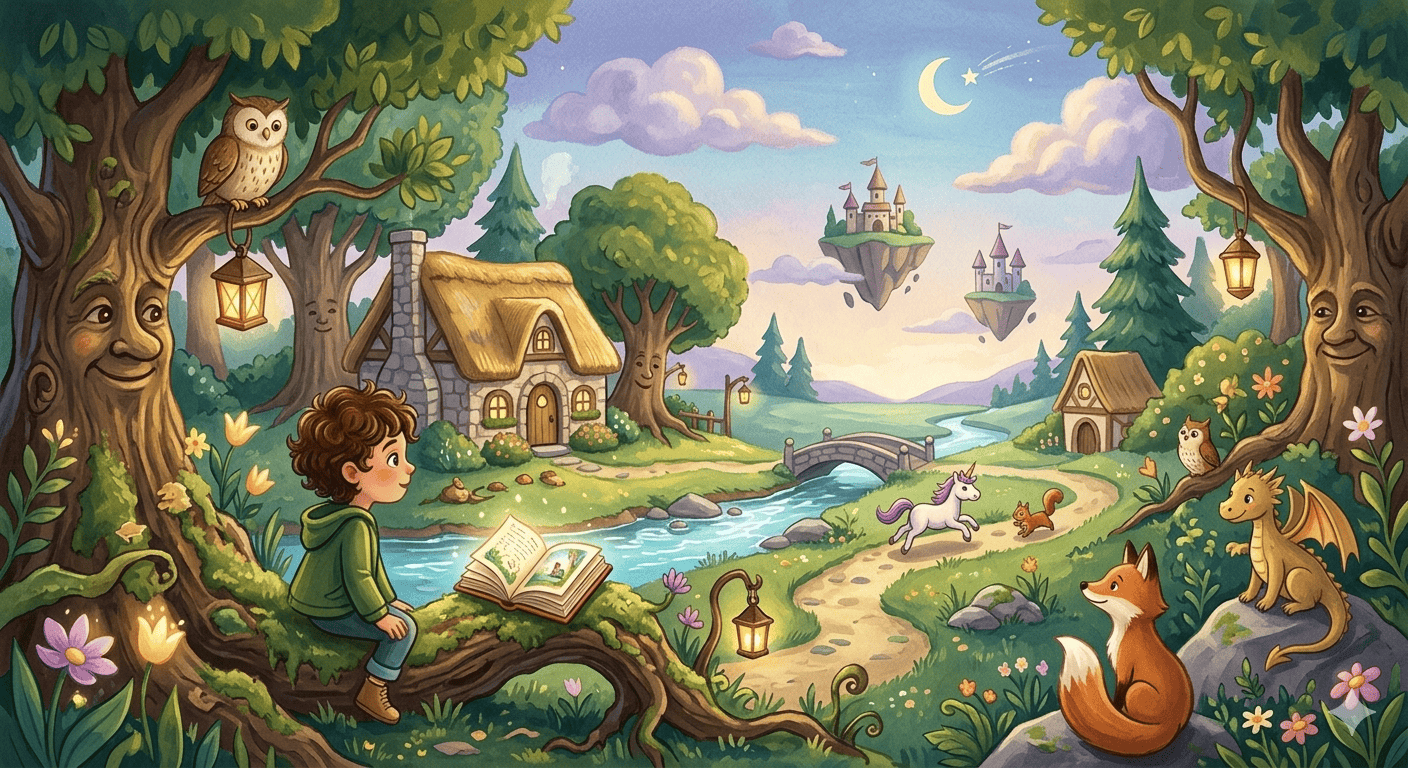
Short stories for kids provide an incredible way to ignite a child’s imagination and foster a deep, lifelong love for reading.
These bite-sized adventures are perfect for busy schedules, offering meaningful lessons and magical worlds that children can explore in just a few minutes.
By choosing to engage with short stories for kids to read online, you give your young readers instant access to diverse characters and thrilling plots right from any device.
Dive into our curated list of enchanting tales today and watch as your child discovers the joy of storytelling!
Table of Contents
1. The Gift of the Magi — O. Henry
Della and Jim were basically broke but crazy about each other.
Della sold her stunning hair to buy a fancy chain for Jim’s prized watch.
Jim secretly pawned that same watch to buy expensive combs for Della’s hair.
When they swapped gifts, they realized they’d both sacrificed their most prized possessions for things they could no longer use.
They were shocked for a second, then just laughed because they figured out that being selfless matters more than “stuff.”
True wealth is just having someone willing to lose everything just to see you smile.
The Mic-Drop: Being broke is a temporary bank account problem; being poor is a state of the heart.
2. The Lottery — Shirley Jackson
In this quiet little village, everyone gathers once a year for a totally “normal” lottery.
Families hang out and chat while a mysterious black box is prepped.
It looks harmless until the names start getting narrowed down to one family, and finally, one person.
Suddenly, the vibe shifts and neighbors stop being friendly to grab heavy stones.
Even friends and relatives join in to kill the “winner” without ever asking why.
This story shows how terrifying traditions can be when people stop questioning the “why” and just follow the crowd.
The Mic-Drop: “But we’ve always done it this way” is arguably the most dangerous sentence in human history.
3. The Tell-Tale Heart — Edgar Allan Poe
A guy keeps insisting he’s totally sane while describing how he stalked an old man.
He was obsessed with the man’s “vulture eye” and spent nights creeping into the room before finally committing murder.
He hid the body under the floorboards and was cool as a cucumber when the cops showed up.
But then, he started hearing a thumping sound—a heartbeat getting louder and louder in his ears.
Convinced the dead man’s heart was accusing him, he snapped and confessed everything to the police.
It’s a wild trip through guilt, paranoia, and a total mental breakdown.
The Mic-Drop: You can hide the body, but you can’t hide from your own brain.
4. The Necklace — Guy de Maupassant
Mathilde was obsessed with looking rich and borrowed a diamond necklace for a fancy party.
She felt like a queen that night, but then she realized the necklace was gone.
Terrified of looking poor, she and her husband took out massive loans to buy a replacement.
They spent ten brutal years working like dogs to pay it off, losing their youth and health in the process.
Finally, she ran into her friend and found out the original necklace was actually a cheap fake.
The whole tragedy was based on a lie and a massive amount of unnecessary pride.
The Mic-Drop: Chasing a “look” can cost you your life; always check the receipt before you sell your soul.
5. A Hunger Artist — Franz Kafka
There was this guy who made a career out of sitting in a cage and starving himself for an audience.
People used to love watching his “art,” but eventually, they got bored and moved on to the next big thing.
He ended up forgotten in a corner of a circus, replaced by more exciting attractions.
Right before he died, he admitted he only starved because he never found any food he actually liked.
They swept him out and replaced him with a lively panther that the crowd actually wanted to see.
It’s a deep look at how fast the public moves on and how lonely it feels to be misunderstood.
The Mic-Drop: If you live for the applause, you’ll die when they stop clapping.
6. The Open Window — Saki
A nervous guy goes to the countryside for some peace and meets a teenage girl with a wild imagination.
She tells him a tragic story about her aunt’s husband disappearing years ago while hunting.
She claims the aunt keeps the window open every night, hoping they’ll finally walk back through it.
When the “ghosts” actually appear walking toward the house, the guy loses his mind and bolts.
Turns out, the girl just made the whole thing up because she was a pro at making up stories on the fly.
It’s a hilarious and slightly mean look at how easily our imaginations can be played by a good storyteller.
The Mic-Drop: A good story is a weapon; if you don’t fact-check your fears, someone will use them against you.
7. Hills Like White Elephants — Ernest Hemingway
A couple is sitting at a train station in Spain, drinking and talking in circles about a “simple procedure.”
They won’t actually say the word “abortion,” but the tension between them is thick enough to cut.
He’s pushing for it, saying things will go back to normal, while she’s feeling totally lost and disconnected.
The hills in the distance look like white elephants—something valuable but ultimately unwanted.
They’re talking, but they aren’t actually saying anything that matters to their future.
The story ends with the train arriving and their massive emotional gap left wide open.
The Mic-Drop: Silence isn’t always peace; what you don’t say is usually what ends up killing the relationship.
8. The Happy Prince — Oscar Wilde
A gold-covered statue of a prince looks over a city and sees how miserable the poor people are.
He asks a little swallow to stay behind and peel off his gold and jewels to give to the needy.
The swallow helps him until the prince is just a grey, ugly hunk of lead and the bird dies from the cold.
The town leaders toss the “ugly” statue in the trash, but the angels see it as the most precious thing in the city.
It’s a beautiful, sad story about how real value has nothing to do with looking shiny on the outside.
The Mic-Drop: Real beauty isn’t about what you’re wearing; it’s about what you’re willing to give away.
9. To Build a Fire — Jack London
A guy decides to hike through the freezing Yukon alone, even though the locals warned him not to.
He thinks he’s too smart to get caught by the cold and ignores every warning sign nature throws at him.
He makes the fatal mistake of building a fire under a snowy tree that dumps its load and kills the flames.
His hands freeze, he panics, and he realizes way too late that he’s not going to make it out alive.
Meanwhile, his dog just watches, instinctively knowing how to survive while the human fails.
The guy dies in the snow, a victim of his own massive ego and lack of respect for the wild.
The Mic-Drop: Nature isn’t your friend; if you don’t respect the elements, they will break you.
10. The Rocking-Horse Winner — D.H. Lawrence
A kid grows up in a house where the parents are obsessed with money and social status.
He figures out that if he rides his rocking horse like a madman, he can predict winning racehorses.
He starts making a fortune for his family in secret, hoping to finally “buy” his mother’s love.
But the more money he makes, the more the house seems to whisper for more and more cash.
He pushes himself so hard to find the next winner that he eventually collapses and dies.
It’s a dark look at how greed can literally consume the most innocent people in a family.
The Mic-Drop: Luck isn’t a substitute for love; money can’t fill a hole in someone’s soul.
11. The Lady, or the Tiger? — Frank R. Stockton
A king has a “fair” trial system where you choose one of two identical doors.
Behind one is a beautiful lady you have to marry; behind the other is a very hungry tiger.
A young man is on trial for dating the king’s daughter, and the princess finds out which door is which.
She hates the lady behind the door, but she also loves the man standing in the arena.
She signals him to pick the right door, and he does, but the story ends right there.
Was she too jealous to see him with another woman, or did her love win out?
The Mic-Drop: The hardest choices aren’t made in court; they’re made in the messy reality of the heart.
12. The Veldt — Ray Bradbury
A family lives in a high-tech house with a virtual reality nursery that brings any thought to life.
The kids become obsessed with a violent African veldt, complete with lions eating in the distance.
The parents realize the kids love the room more than them and try to shut the whole house down.
The kids trick the parents into the nursery and lock the door from the outside.
The virtual lions turn out to be a bit too real, and the parents don’t make it out.
It’s a creepy warning about letting gadgets replace the emotional connection in a family.
The Mic-Drop: If you let a machine take your place as a parent, don’t be surprised when the kids stop acting human.
13. Emotional Inheritance Story
A woman gets her mom’s pearl necklace and initially feels like it’s just a bit of old, dusty history.
She keeps it in a box until she finally wears it to a big event and feels something shift.
Suddenly, she feels the weight of her mom’s sacrifices and the stories behind every single pearl.
It stops being an object and starts being a physical connection to her roots and her identity.
She realizes she’s not just wearing jewelry; she’s carrying her family’s legacy with her.
It’s all about figuring out who you are by embracing the memories you’ve inherited.
The Mic-Drop: You don’t just inherit eye color; you inherit stories that help define who you are.
14. The Ones Who Walk Away from Omelas — Ursula K. Le Guin
Omelas is the perfect city where everyone is happy, the festivals are great, and life is beautiful.
But there’s a catch: for everyone to stay happy, one innocent child has to be kept in a dark, filthy room.
Everyone in the city knows about the kid, and most people justify it as a necessary evil.
But some people see the child and realize they can’t live with the guilt of that “perfect” life.
They don’t argue or protest; they just quietly walk out of the city and never look back.
It’s a massive question about what our personal comfort actually costs other people.
The Mic-Drop: Integrity isn’t about being happy; it’s about refusing to profit from someone else’s pain.
15. A Good Man Is Hard to Find — Flannery O’Connor
A family goes on a road trip, and the grandmother is being a total pain the entire time.
They end up in a car wreck in the middle of nowhere and run into an escaped killer called “The Misfit.”
He starts picking off the family members while the grandmother tries to talk her way out of it.
Right before he kills her, she has a moment of actual clarity and sees him as a human being worth loving.
It’s a brutal, messy look at grace and the fact that some people only find their souls at the very end.
The Mic-Drop: Sometimes it takes a total disaster to wake you up to what really matters.
Each narrative is carefully crafted to hold their attention while building the confidence they need to tackle more complex books in the future.
You can easily browse through various genres and themes to find the perfect tale that matches your child’s unique interests and curiosity.
Click here to explore our full library of vibrant adventures and begin creating unforgettable reading memories with your family right now!

Leave a Reply