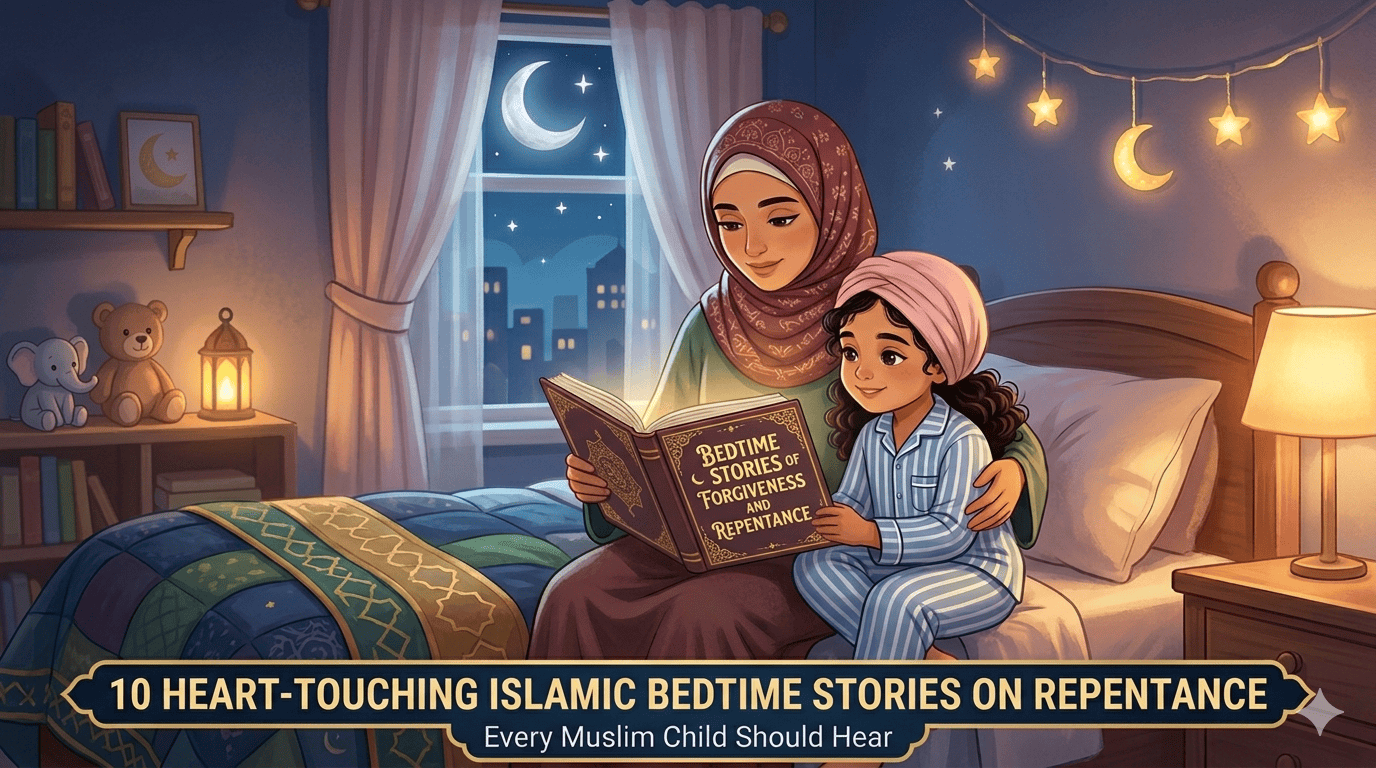
Children learn some of life’s most important lessons through stories. That’s why Islamic bedtime stories are a wonderful way to teach young hearts about faith, kindness, honesty, and the mercy of Allah.
One of the most beautiful teachings in Islam is that Allah always welcomes those who sincerely repent and seek His forgiveness. No matter how big or small a mistake may be, the door of tawbah (repentance) remains open.
The Qur’an repeatedly reminds believers to return to Allah, ask for forgiveness, and strive to become better people.
In this collection of 10 Islamic bedtime stories, children will meet relatable characters who make mistakes, learn valuable lessons, and discover the power of repentance through inspiring Qur’anic verses.
From a boy who tears his grandfather’s kite to a girl who learns the courage to admit her mistakes, each story is based on a Quranic ayah about forgiveness, mercy, and second chances.
These stories are designed to help children understand that making mistakes is part of being human, but seeking forgiveness, correcting our actions, and trusting in Allah’s mercy are signs of a strong believer.
Whether you’re a parent, teacher, or caregiver looking for meaningful Islamic bedtime stories, these Quran-inspired tales will encourage young readers to develop good character, strengthen their faith, and remember that Allah is the Most Forgiving and Most Merciful.
Let’s begin our journey from mistakes to mercy through the timeless guidance of the Holy Qur’an.
Table of Contents
1: The Broken Kite and the Verse of Hope
Ayaan was excited to fly the beautiful blue kite his grandfather had given him, but one small choice would soon change everything.
As he raced to impress his friends Kashan and Zuraiz, he had no idea a valuable lesson was waiting for him.
Grandfather: “Ayaan, don’t fly your blue kite near the thorn trees.”
Ayaan: “Don’t worry, Grandfather. I’ll be careful.”
Kashan: “That’s a beautiful kite!”
Ayaan: “My grandfather gave it to me. Watch how high I can fly it!”
Zuraiz: “It’s getting close to the thorn trees.”
Ayaan: “It’s fine. I know what I’m doing.”
Kashan: “Look out!”
Ayaan: “Oh no!”
Zuraiz: “The kite is stuck!”
Ayaan: “Maybe I can pull it free.”
Kashan: “Be careful!”
Ayaan: “No! My kite tore into pieces!”
Grandfather: “Ayaan, I haven’t seen you much lately. What’s wrong, my boy?”
Ayaan: “Nothing.”
Grandfather: “Are you sure?”
Ayaan: “…Grandfather, I need to show you something.”
Grandfather: “What is it?”
Ayaan: “My kite. It’s torn.”
Grandfather: “How did this happen?”
Ayaan: “I flew it near the thorn trees. I ignored your warning.”
Grandfather: “I see.”
Ayaan: “I disobeyed you. I don’t think you’ll forgive me.”
Grandfather: “Listen to this verse from the Qur’an: ‘O My servants who have transgressed against themselves, do not despair of the mercy of Allah. Indeed, Allah forgives all sins. Indeed, it is He who is the Forgiving, the Merciful.’ (Surah Az-Zumar, 39:53)“
Ayaan: “What does that mean?”
Grandfather: “It means that when we make mistakes, we shouldn’t run away from forgiveness. We should return to Allah, admit our wrongs, and ask for His mercy.”
Ayaan: “Then I’m sorry, Grandfather. I was wrong.”
Grandfather: “Do you truly regret what you did?”
Ayaan: “Yes, I do.”
Grandfather: “Then I forgive you.”
Ayaan: “You do?”
Grandfather: “Of course. Everyone makes mistakes. The important thing is to learn from them.”
Ayaan: “Thank you, Grandfather.”
Grandfather: “Now, shall we repair this kite together?”
Ayaan: “Yes, let’s do it!”
Ayaan: “Look, Grandfather! The kite is flying high again!”
Grandfather: “And where are we flying it today?”
Ayaan: “Far away from the thorn trees!”
Grandfather: “Excellent.”
Ayaan: “I won’t forget your advice again.”
Grandfather: “That’s a lesson worth remembering.
Moral: Never lose hope in Allah’s mercy. Sincere repentance brings forgiveness.
2: Sara’s Muddy Shoes
Sara had new white shoes. One rainy day, her mother asked her to help bring groceries inside.
“I don’t want my shoes to get dirty,” Sara said.
Her younger brother Yusuf ran outside and helped instead.
That night Sara felt guilty. She remembered how tired her mother had looked.
The next morning she apologized.
“I’m sorry, Mom. I was selfish.”
Her mother hugged her.
Later that day, Sara’s grandmother visited. Hearing the story, she opened her Qur’an and read:
“Indeed, Allah loves those who are constantly repentant.” (2:222)
“Does Allah really love people who make mistakes?” Sara asked.
Grandmother smiled.
“Allah loves people who realize their mistakes, say sorry, and try to improve.”
Sara thought about that all day.
The next week she volunteered to help carry groceries, clean the kitchen, and assist her younger brother with homework.
She felt happier than before.
Whenever she remembered her selfish choice, she also remembered Allah’s love for those who repent and improve.
Moral: True repentance means changing our actions for the better.
3: The Lost Library Book
Bilal borrowed an exciting adventure book from the school library.
One weekend he took it to the park. While playing football, he left it on a bench.
When he returned, it was gone.
Bilal searched everywhere.
The book had disappeared.
All week he worried about facing the librarian.
On Friday he finally walked into the library.
“I lost the book,” he said quietly. “I’m very sorry.”
The librarian thanked him for being honest.
After school, Bilal told his father what happened.
His father opened the Qur’an and read:
“And it is He who accepts repentance from His servants and pardons misdeeds.” (42:25)
“Allah teaches us something important here,” Father said.
“What’s that?” asked Bilal.
“When we make mistakes, we should admit them and try to fix them.”
The next day Bilal offered to help organize library shelves after school.
The librarian appreciated his effort.
After a week of helping, she handed him another book.
“You earned a second chance.”
Bilal smiled.
He learned that honesty and repentance are stronger than fear and hiding.
Moral: Allah accepts sincere repentance, and people often appreciate honesty too.
4: The Race Against Tomorrow
Hamza loved playing football after school. One day, while rushing to join a game, he accidentally knocked over his neighbor’s flower pot.
The clay pot shattered into pieces.
Hamza looked around. No one had seen him.
“I’ll tell her tomorrow,” he thought.
The next day he delayed again.
And the day after that too.
Each time he passed the neighbor’s house, his heart felt heavier.
One evening, Hamza’s mother noticed he was unusually quiet.
After hearing the story, she opened the Qur’an and read:
“Turn to your Lord in repentance and submit to Him before the punishment comes upon you…” (39:54)
Hamza listened carefully.
“Why does Allah tell us to repent quickly?” he asked.
“Because delaying repentance makes our hearts harder,” his mother replied. “When we know we’ve done wrong, we should correct it as soon as possible.”
The next morning Hamza knocked on the neighbor’s door.
“I broke your flower pot,” he admitted. “I’m sorry. I’ve brought some savings to help replace it.”
The neighbor smiled kindly.
“Thank you for telling the truth.”
Together they planted new flowers in a replacement pot.
As Hamza watered the flowers, he felt a burden lift from his chest.
He learned that waiting only makes repentance harder, while honesty brings peace.
Moral: Don’t delay repentance. The sooner we correct our mistakes, the lighter our hearts become.
5: The Empty Bird Feeder
Mariam loved feeding the birds in her garden.
Every morning she filled a wooden bird feeder hanging from a tree.
One week, her family became busy preparing for visitors. Mariam forgot about the feeder completely.
Days passed.
When she finally looked outside, the feeder was empty.
The birds that usually visited were nowhere to be seen.
Mariam felt terrible.
“I forgot about them,” she said sadly.
Her grandfather sat beside her and opened the Qur’an.
He read:
“Seek your Lord’s forgiveness and then turn to Him in repentance. Indeed, my Lord is Merciful and Loving.” (11:90)
“Loving?” Mariam asked.
“Yes,” Grandfather replied. “Allah is not only forgiving. He is loving. When we return to Him sincerely, He welcomes us.”
Mariam thought about this.
The next morning she cleaned the feeder, filled it with fresh seeds, and placed a small bowl of water nearby.
For several days she remembered to care for it.
Soon the birds returned.
Their cheerful chirping filled the garden again.
Watching them, Mariam understood something important.
Repentance wasn’t only about feeling sorry. It was about returning to what was right.
Every time she heard the birds singing, she remembered Allah’s mercy and love.
Moral: Allah is Merciful and Loving. Repentance means returning to good actions after a mista
6: The Torn Painting
Zayd loved drawing.
One afternoon, he became jealous when his friend Umar won first prize in the school art competition.
After class, Zayd angrily tore a corner of Umar’s painting.
The moment he did it, he regretted it.
Nobody saw him.
But Zayd knew what he had done.
That evening he told his older sister.
She listened quietly and then opened the Qur’an.
She read:
“Except for those who repent, believe, and do righteous deeds. For them Allah will replace their evil deeds with good.” (25:70)
“Replace bad deeds with good?” Zayd asked.
“Yes,” she replied. “When repentance is sincere and followed by good actions, Allah’s mercy is immense.”
The next day Zayd confessed to Umar.
“I’m sorry. I damaged your painting.”
Umar was disappointed but appreciated the honesty.
Zayd spent his lunch breaks helping Umar repair the artwork. He also volunteered to help prepare decorations for the school exhibition.
By the end of the week, the painting looked beautiful again.
More importantly, Zayd’s jealousy had turned into friendship.
He learned that repentance is not only about stopping wrong actions—it is about replacing them with good ones.
Moral: Sincere repentance transforms mistakes into opportunities for goodn
7: The Forgotten Homework
Amina forgot to complete an important homework assignment.
When her teacher asked about it, she blamed her younger brother.
“He distracted me,” she said.
Her teacher accepted the explanation.
But Amina felt uncomfortable all day.
At home she told her mother the truth.
Her mother gently opened the Qur’an and read:
“Our Lord, we have wronged ourselves. If You do not forgive us and have mercy upon us, we will surely be among the losers.” (7:23)
She explained, “This was the prayer of Adam and Hawwa after they made a mistake.”
Amina listened closely.
“They didn’t blame anyone else,” her mother continued. “They admitted their mistake.”
The next morning Amina approached her teacher.
“I wasn’t truthful yesterday,” she admitted. “My brother wasn’t responsible. I forgot the homework myself.”
The teacher appreciated her honesty.
“Thank you for correcting your mistake.”
Amina completed the assignment that evening and turned it in the next day.
She felt relieved.
The prayer of Adam stayed in her heart.
Whenever she made mistakes afterward, she remembered to take responsibility instead of blaming others.
Moral: True repentance begins when we honestly admit our own mistakes.
8: The Cracked Window
Khalid and his friends were playing cricket in the street.
One powerful swing sent the ball crashing through a neighbor’s window.
The glass shattered.
His friends ran away.
Khalid wanted to run too.
Instead, he remembered what his father often taught him about honesty.
That evening he told his father everything.
His father opened the Qur’an and read:
“But whoever repents after his wrongdoing and reforms, indeed Allah will turn to him in forgiveness.” (5:39)
“What does ‘reforms’ mean?” Khalid asked.
“It means fixing the harm when possible.”
The next day Khalid knocked on the neighbor’s door.
“I broke your window. I’m sorry.”
Using money he had saved for months, he contributed toward repairing it.
The neighbor was surprised.
“That was very responsible of you.”
After the window was fixed, Khalid felt proud—not because he had made a mistake, but because he had corrected it.
He learned that repentance is more than words.
It includes making things right.
Moral: Repentance should be followed by sincere efforts to repair the harm we caused
9: The Mean Message
One afternoon, Noor became upset with her friend Hiba.
In anger, she sent a rude message in their class group chat.
The message spread quickly.
Soon Noor regretted it.
She couldn’t sleep that night.
The next evening she spoke with her aunt.
Her aunt opened the Qur’an and read:
“And those who, when they commit an immorality or wrong themselves, remember Allah and seek forgiveness…” (3:135)
“Even good people make mistakes,” her aunt said.
“Then what makes them good?” Noor asked.
“They don’t continue doing wrong after realizing it.”
The next morning Noor deleted the message and apologized publicly.
“I was wrong. I’m sorry.”
She also apologized privately to Hiba.
Hiba forgave her.
Their friendship slowly healed.
Noor learned that mistakes do not define a person.
What matters is remembering Allah, seeking forgiveness, and refusing to continue in wrongdoing.
Moral: Believers are not perfect, but they return to Allah whenever they make mistakes.
10: The Garden That Bloomed Again
Yusuf loved helping his grandmother in her garden.
One summer, many plants began to wilt.
The weather was hot, and very little rain had fallen.
Grandmother continued caring for the garden patiently.
One day Yusuf noticed that she often repeated:
“Astaghfirullah. Astaghfirullah.”
“Why do you say that so much?” he asked.
She smiled and opened the Qur’an.
She read:
“Ask forgiveness of your Lord. Indeed, He is ever a Perpetual Forgiver. He will send rain from the sky upon you in abundance…” (71:10–11)
“Does seeking forgiveness really matter that much?” Yusuf asked.
“It helps purify our hearts,” Grandmother replied. “And Allah sends blessings in ways we may not expect.”
Inspired, Yusuf began saying Astaghfirullah regularly.
He also worked harder in the garden, watering plants and pulling weeds.
A few weeks later, gentle rain finally arrived.
The flowers began blooming again.
Yusuf watched butterflies flutter among colorful blossoms.
He understood that seeking forgiveness wasn’t a magic formula. It was a way of staying connected to Allah, remaining humble, and appreciating His blessings.
Every morning thereafter, he remembered to seek Allah’s forgiveness and thank Him for His countless gifts.
Moral: Regularly seeking Allah’s forgiveness brings spiritual blessings and keeps our hearts close to Him.
Every child makes mistakes, but the Qur’an teaches us that mistakes can become stepping stones to growth when we turn back to Allah with sincerity.
Through these Islamic bedtime stories, children learn valuable lessons about repentance, honesty, responsibility, kindness, and the endless mercy of Allah.
We hope these Quran-inspired stories help your little ones develop strong character, deepen their love for Islam, and understand the beauty of seeking forgiveness.
📖 Which story was your child’s favorite? Share it in the comments below!
💙 If you enjoyed these Islamic bedtime stories, don’t forget to share them with family and friends so more children can benefit from these timeless Quranic lessons.
🌙 For more Islamic bedtime stories, Quran stories for kids, and faith-building lessons for young Muslims, bookmark this page and visit again for new stories every week.
May Allah fill our hearts with faith, guide us to sincere repentance, and make us among those He loves and forgives. Ameen.

Leave a Reply