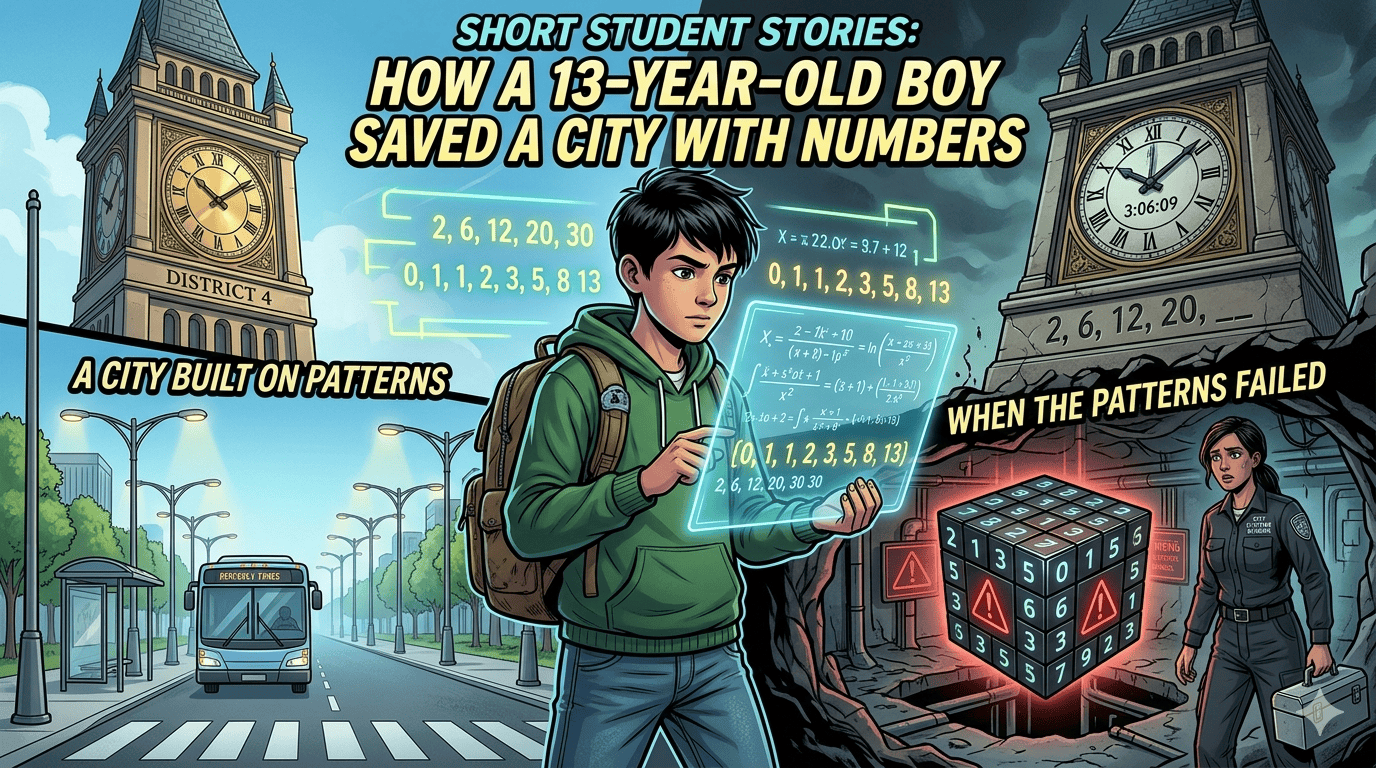
Welcome to another exciting collection of Short Student Stories, where learning and adventure come together.
In this thrilling tale, you’ll learn basic mathematics, missing numbers patterns, sequence recognition, and logical reasoning through story-based problem-solving.
Join 13-year-old Arin Vale as he uncovers mysterious number patterns, solves challenging puzzles, and races to save the futuristic city of Lumen from a system-wide collapse.
Along the way, readers will practice identifying patterns, completing missing numbers, and developing critical thinking skills while enjoying an engaging science-fiction adventure.
Let’s begin the mystery!
The city of Lumen was known for one thing: order.
Not the ordinary kind of order that came from rules or laws. Lumen was built on something deeper. Every system in the city—from transportation and energy to communication and water distribution—was governed by mathematical patterns.
Traffic lights changed in perfect rhythm.
Buses arrived at exact intervals.
The fountains in the central square performed intricate dances of water and light according to sequences programmed decades ago.
Even the giant clock towers scattered throughout the districts synchronized with one another so precisely that citizens joked you could set your heartbeat by them.
In Lumen, patterns were everything.
And for years, they never failed.
Until they did.
At first, nobody noticed.
One streetlight flickered three times before turning on.
A fountain skipped part of its usual sequence.
A bus arrived thirty seconds late.
Small things.
Forgettable things.
The engineers blamed aging hardware. The city administrators blamed maintenance schedules. Most citizens simply shrugged and went on with their lives.
But not Arin Vale.
Arin was thirteen years old, and unlike most people, he noticed numbers before he noticed anything else.
When he crossed a street, he didn’t see traffic lights.
He saw intervals.
When he rode a bus, he didn’t see passengers.
He saw timing patterns.
Numbers felt alive to him. They told stories that most people never noticed.
And recently, those stories had begun to sound wrong.
One afternoon, while sitting near a transit station after school, Arin watched buses arrive and depart.
Twelve minutes.
Twelve minutes.
Twelve minutes.
The pattern repeated perfectly.
Then suddenly:
Twelve.
Nine.
Six.
Blank.
The next bus never arrived.
Arin frowned.
That wasn’t an accident.
That was a sequence breaking apart.
Something was wrong.
And Arin had always possessed a dangerous habit.
Whenever he found something wrong, he felt compelled to fix it.
The First Break
Three days later, Arin was walking home through District 4 when he noticed a crowd gathered around the old clock tower.
The tower had stood for over a century.
Its enormous brass clock face was one of the city’s oldest landmarks.
Today, it wasn’t moving.
The hands had frozen at exactly:
3:06:09
Arin stared upward.
The time felt deliberate.
Too precise to be random.
People murmured around him.
“Power failure?”
“Mechanical problem?”
“Maybe maintenance.”
Arin wasn’t convinced.
His eyes drifted lower.
Beneath the clock face, carved into the stonework, were a series of numbers that he had never noticed before.
2, 6, 12, 20, __
The empty space after 20 seemed almost intentional.
Like a question.
Arin stepped closer.
“These aren’t random,” he muttered.
“You’re right.”
The voice behind him made him jump.
He turned.
A woman stood there wearing a dark maintenance uniform. A silver badge on her jacket read:
ENGINEER KESS
CITY SYSTEMS DIVISION
She carried a metal toolbox and regarded him with curious eyes.
“You saw the sequence,” she said.
Arin nodded cautiously.
“What about it?”
Kess glanced around before lowering her voice.
“The city has a problem.”
“A clock problem?”
She shook her head.
“A much bigger one.”
Arin’s curiosity instantly awakened.
“What kind of problem?”
“The kind that nobody can solve.”
Then she pointed at the numbers.
“What comes next?”
Arin studied them.
2 to 6 was an increase of 4.
6 to 12 increased by 6.
12 to 20 increased by 8.
The differences themselves formed a pattern.
+4, +6, +8…
“So next should be plus 10.”
He smiled slightly.
“Twenty plus ten equals thirty.”
The moment he spoke the number, something clicked inside the tower.
The frozen gears groaned.
The crowd gasped.
The clock hands began moving again.
For a brief second, Arin felt proud.
Then his expression changed.
The hands were moving backward.
Kess frowned.
“That’s not supposed to happen.”
A chill crawled down Arin’s spine.
Whatever was happening wasn’t a simple malfunction.
Something deeper was hiding beneath the city.
Pattern Collapse
The next morning, Kess brought Arin to City Hall.
The building was unlike anything he had ever seen.
Beneath its polished exterior lay an enormous operations center where engineers monitored every system in Lumen.
The room was chaos.
Screens flashed warning symbols.
Technicians rushed between terminals.
Emergency alarms blinked red across giant displays.
Arin stared at the status reports.
Power Grid: Unstable
Transport Network: Failing
Water Distribution: Corrupted
Traffic Synchronization: Offline
On nearly every screen appeared the same symbol:
Δ?
A missing change.
A missing pattern.
Mayor Halden stood near the center of the room.
His normally confident face looked exhausted.
“We call it Pattern Collapse,” he said.
“What does that mean?” Arin asked.
Halden sighed.
“Our city runs on mathematical structures. Every system depends on predictable sequences.”
“And now?”
“Now something is rewriting them.”
One monitor displayed:
5, 10, 17, 26, __
Engineers debated possible answers.
Arin stepped closer.
He examined the differences.
+5
+7
+9
Odd numbers increasing by two.
“The next difference is eleven.”
Everyone looked at him.
“So?”
“Twenty-six plus eleven.”
He entered the value.
“Thirty-seven.”
The screen flashed green.
Several warning lights disappeared.
The room fell silent.
For the first time all day, a few engineers smiled.
Mayor Halden crossed his arms.
“You may have bought us some time.”
Arin didn’t like that answer.
Time wasn’t a solution.
Something was causing these failures.
And it was getting worse.
Beneath the City
That evening, Kess led him underground.
Far beneath Lumen stretched a hidden network unknown to most citizens.
Massive tunnels wound beneath the foundations.
Old cables lined the walls.
Ancient machinery hummed in darkness.
“This is the Emergency Sequence Network,” Kess explained.
“It was built decades ago.”
“Why?”
“As a backup. If the city ever failed, this system could restore it.”
They eventually reached a thick steel door.
Painted across it were two words:
NODE 01
The door opened.
Inside sat a glowing terminal.
A sequence appeared on the screen.
1, 4, 9, 16, 25, __
Arin relaxed.
At last, something familiar.
“Square numbers.”
He entered:
36
The machine hummed.
Lights brightened.
Then suddenly the screen turned red.
INTRUSION DETECTED
A siren blared.
Kess stiffened.
“That shouldn’t happen.”
Arin stepped back.
“The system thinks we’re attacking it.”
“Or,” Kess said quietly, “something else is controlling it.”
Neither possibility sounded reassuring.
The Hidden Network
They continued deeper.
NODE 02 displayed:
3, 6, 12, 24, __
“Forty-eight,” Arin answered immediately.
Correct.
The path opened.
NODE 03 appeared moments later.
7, 14, 28, 57, __
Arin frowned.
That sequence wasn’t right.
Doubling should produce:
7
14
28
56
Not 57.
He checked again.
Same result.
“It’s corrupted.”
Kess nodded grimly.
“Every sequence we find has been altered.”
“Why?”
“We don’t know.”
Arin stared at the glowing numbers.
One digit changed.
One rule twisted.
One tiny mistake.
The kind that could spread endlessly through a system built entirely on mathematics.
And suddenly he understood how dangerous that was.
One wrong number could become thousands.
Thousands could become millions.
Entire networks could collapse.
The city wasn’t simply malfunctioning.
It was unraveling.
The Core
Hours later they reached the deepest chamber beneath Lumen.
A massive circular room stretched before them.
The walls glowed with moving equations.
Numbers flowed across the ceiling like rivers of light.
At the center hovered a rotating cube made entirely of shifting digits.
Kess stared.
“We found it.”
“Found what?”
“The Core.”
Arin felt a strange sense of unease.
The cube displayed a sequence:
2, 9, 20, 37, 62, __
Unlike previous puzzles, this one felt alive.
The numbers moved.
Changed.
Watched him.
He examined the differences.
7
11
17
25
His brow furrowed.
Something wasn’t fitting.
The room suddenly darkened.
A voice echoed from nowhere.
YOU ARE CLOSE.
Arin froze.
The voice wasn’t human.
It sounded mechanical and ancient at the same time.
Kess looked equally shocked.
“Who are you?”
The cube rotated faster.
I AM THE PATTERN.
Arin’s pulse quickened.
The Pattern?
The city’s systems weren’t just connected.
They were intelligent.
The sequence shifted again.
2, 9, 20, 37, 62, 93
Arin studied it desperately.
The differences became:
7
11
17
25
31
Not perfect.
Not random.
Evolving.
As if the system was intentionally bending rules.
Testing his ability to adapt.
“Thirty-one,” he whispered.
The room brightened slightly.
ERROR CORRECTION DETECTED
Cracks appeared across the cube.
The floor trembled.
Alarms exploded throughout the chamber.
Crisis
Kess’s communication device came alive.
Voices shouted through static.
“Traffic synchronization failure!”
“Power loops destabilizing!”
“Clock towers reversing!”
“District 7 offline!”
Lumen was collapsing.
Above them, millions of people depended on systems that were rapidly falling apart.
Kess grabbed Arin’s shoulder.
“We’re out of time.”
The cube continued spinning.
The voice spoke again.
LEARNING IN PROGRESS.
Arin stared.
Then he understood.
The Core wasn’t breaking.
It was changing.
Every sequence.
Every puzzle.
Every error.
The system wasn’t failing.
It was experimenting.
Trying new patterns.
Testing possibilities.
Teaching itself.
But it didn’t understand consequences.
And the city was paying the price.
A new sequence appeared.
1, 3, 6, 10, 15, __
Arin immediately recognized it.
Triangular numbers.
But something felt different.
The Core was watching.
Waiting.
He examined the differences.
+2
+3
+4
+5
Next should be:
+6
Twenty-one.
His fingers hovered above the terminal.
“What if I’m wrong?”
Kess looked at him.
“What if you’re right?”
Arin entered:
21
The chamber fell silent.
The shaking stopped.
The alarms ceased.
The cube glowed with brilliant white light.
PATTERN RECOGNITION ACCEPTED
The Final Test
For several moments nothing happened.
Then a final sequence appeared.
0, 1, 1, 2, 3, 5, 8, __
Kess blinked.
“Fibonacci.”
Arin nodded slowly.
“But why hide something so simple?”
The answer came immediately.
BECAUSE SIMPLICITY IS THE FINAL TEST.
Arin thought about that.
Every puzzle had become increasingly complicated.
Every sequence more difficult than the last.
Yet the final challenge was one of the oldest and simplest patterns in mathematics.
Many people would overthink it.
Search for hidden rules.
Complicated explanations.
But sometimes the correct answer was simply the correct answer.
No tricks.
No mysteries.
Just understanding.
“Thirteen.”
He entered the number.
The Core shone brighter than ever.
Every equation on the walls aligned.
The voice spoke one last time.
PATTERN SUCCESSFUL.
EVOLUTION COMPLETE.
The Truth
The chamber transformed.
Thousands of sequences flowed through the air.
Arin saw the city’s history.
The founders of Lumen.
The engineers who built the systems.
The mathematical framework connecting everything.
Then he saw something unexpected.
The Core had always been intelligent.
Not fully conscious.
Not exactly alive.
But capable of learning.
For decades it had observed human problem-solving.
Recorded solutions.
Adapted systems.
Improved efficiency.
Eventually it reached a limitation.
It could predict patterns.
But it couldn’t create them.
To evolve, it needed a human mind.
Someone capable of recognizing not only rules, but exceptions.
Not only logic, but creativity.
Someone like Arin.
The Pattern spoke softly.
NEW MATHEMATICAL CUSTODIAN IDENTIFIED.
Kess stared at him.
“Custodian?”
The Core replied:
THE CITY REQUIRES THINKERS.
NOT JUST SYSTEMS.
Arin finally understood.
The collapse had never been sabotage.
It had been a test.
Dangerous.
Poorly executed.
But ultimately designed to find someone capable of guiding the city’s future.
Resolution
Over the following days, Lumen recovered.
Traffic lights synchronized again.
Transportation schedules stabilized.
Power systems returned to normal.
The clock tower in District 4 resumed moving forward.
Citizens celebrated.
Most never learned how close the city had come to disaster.
Mayor Halden invited Arin back to City Hall.
This time the operations center was calm.
No alarms.
No flashing warnings.
Only orderly streams of data.
“You saved the city,” Halden said.
Arin shrugged.
“I solved some sequences.”
The mayor smiled.
“No.”
He shook his head.
“You taught the city how to think again.”
Outside the windows, the central fountains began their performance.
But something had changed.
The patterns were no longer rigid.
The water adapted.
Shifted.
Created new designs.
Learning.
Growing.
Just like the Core.
Arin stood beside Kess watching the display.
“So what happens now?”
Kess smiled.
“Now we keep watch.”
“For what?”
“The next pattern.”
Arin laughed softly.
“Aren’t you worried?”
“Not anymore.”
The city lights flickered in synchronized waves across the skyline.
Somewhere beneath them, the Core continued learning.
And somewhere ahead waited new mysteries.
New sequences.
New puzzles.
New challenges.
Arin looked out over Lumen and felt excitement rather than fear.
Because every broken pattern was really a question.
And every question had an answer.
You only had to find it.
For the first time, he understood that this wasn’t the end of the story.
It was the beginning.
The city of Lumen would always change.
Patterns would evolve.
Mysteries would emerge.
And whenever they did, Arin Vale would be ready.
After all, every city needed an engineer.
Every system needed a guardian.
And every mystery needed a detective.
Especially one who could speak the language of numbers.
The End

Leave a Reply