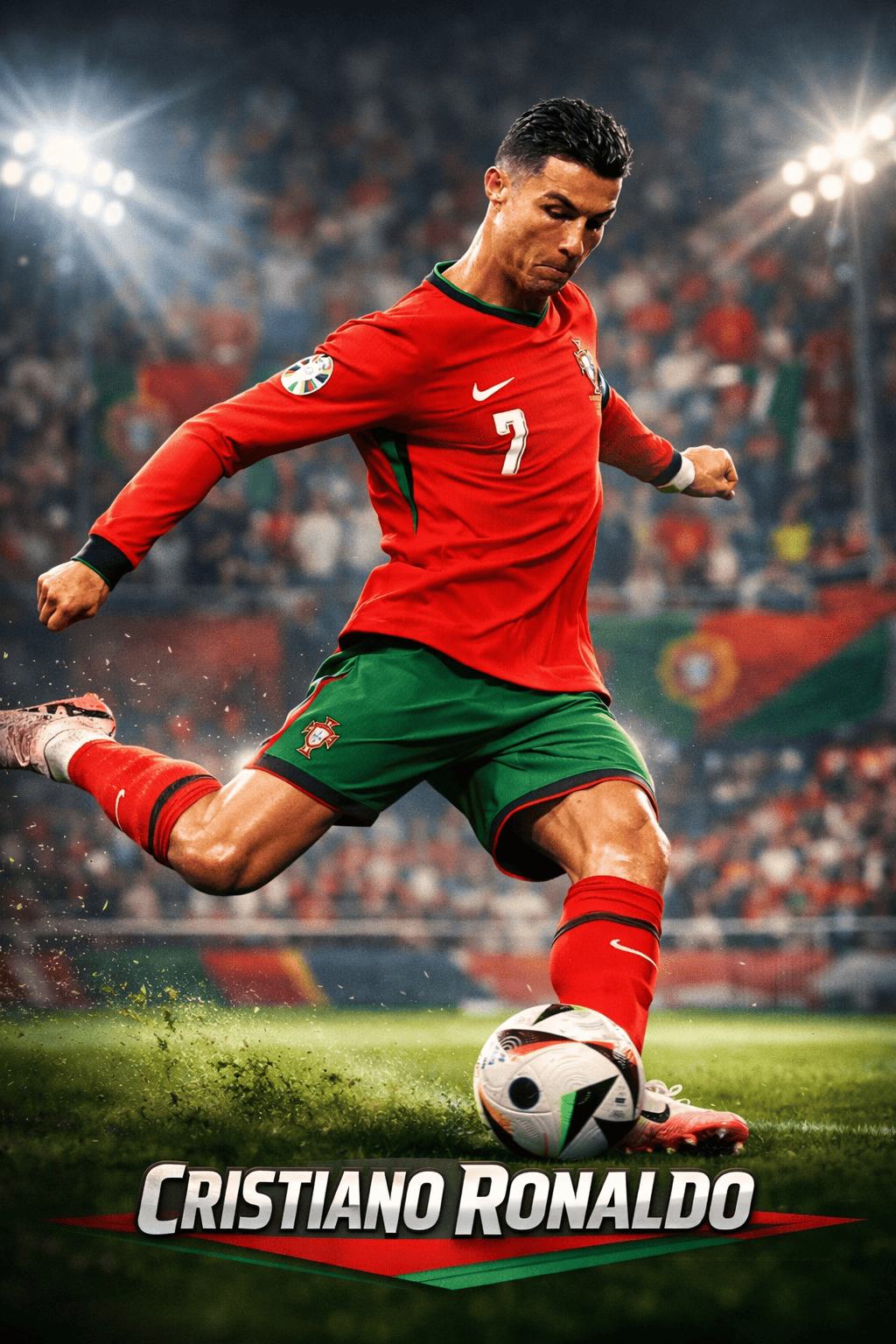
Have you ever wondered what it truly takes to rise from the absolute bottom and conquer the world through sheer, unyielding willpower?
This emotional Cristiano Ronaldo motivational story pulls back the curtain on the glitz and glamour of modern football to reveal the raw sacrifices, hidden heartbreaks, and brutal work ethic of a boy who started with nothing.
From the damp, leaking streets of Madeira to a terrifying childhood heart surgery, you are about to discover how an unmatched obsession with greatness turned an unwanted child into a global phenomenon, offering powerful life lessons that will inspire you to look at your own obstacles in a completely new light.
Table of Contents
The Fragile Beginnings in Madeira
The Atlantic Ocean crashed relentlessly against the jagged volcanic cliffs of Funchal, Madeira, mirroring the turbulent financial storms that battered the impoverished household of Maria Dolores dos Santos Aveiro and José Dinis Aveiro.
On February 5, 1985, a fourth and unplanned child arrived into this world of severe hardship, a boy whose mother had once desperately contemplated aborting him because the family simply lacked the means to put food on the table.
They named him Cristiano Ronaldo dos Santos Aveiro, with the secondary name chosen as an eccentric tribute to Ronald Reagan, the favorite American actor of a father who was already losing his soul to the deep, dark abyss of alcoholism.
Home was a cramped, tin-roofed shack in the hillside parish of Santo António, a fragile structure where the young boy shared a single, drafty bedroom with his three older siblings.
Amidst the heavy stench of cheap alcohol, the stinging sting of systemic poverty, and the constant groans of a leaking roof, the young Cristiano began writing a classic from rags to riches football story.
He played football on the perilous, sloping cobblestone streets, using makeshift goals and refusing to let the steep terrain of Madeira halt the frantic rhythm of his bare feet.
His father worked tirelessly as a municipal gardener and a part-time kit man for the local club Andorinha, a dual life that allowed the young boy to immerse himself fully in the chaotic beauty of organized sports.
The neighborhood kids quickly noticed that this skinny, hyperactive boy possessed an alarming obsession with winning, often breaking into floods of tears whenever a teammate failed to pass him the ball.
This emotional volatility earned him the childhood nickname “crybaby,” an early testament to a raw obsession to success story that would one day define his entire professional existence.
By the time he turned ten, the raw, unrefined magic in his boots attracted Nacional, kickstarting the legendary rise of Cristiano Ronaldo story that began to spread across the island like wildfire.
A Lonely Exile in Lisbon
In 1997, at just twelve years old, the skinny kid from Madeira packed a single suitcase and boarded a terrifying flight to Lisbon for a legendary three-day trial with Sporting CP.
The club scouts watched in absolute awe as the boy manipulated the ball with a supernatural velocity, prompting them to immediately sign him for a fee of fifteen hundred pounds.
The physical relocation from the slow, familiar rhythms of Madeira to the daunting metropolis of Lisbon shattered the young boy’s emotional world.
He spent his nights crying into his pillow, deeply humiliated by his classmates who mocked his thick, distinct Madeiran accent.
This period began a profoundly lonely journey to success story, where a young boy had to find strength within his own isolation.
School became a battleground of intense alienation, culminating in a dramatic flashpoint where an adolescent Ronaldo threw a chair at a teacher who he felt had deeply disrespected his background.
At age fourteen, with the blessing of his exhausted mother, Ronaldo made the fateful decision to completely abandon his formal education and commit his entire soul to the pursuit of professional football.
The Terrifying Heart Scare
Tragedy and fear, however, lurked just around the corner, waiting to derail the young prodigy’s grand ambitions before they could ever truly begin.
During a routine medical screening, club doctors discovered that his heart raced at a terrifying, irregular speed even when his body was completely at rest.
This diagnosis of tachycardia threatened to end his footballing dreams permanently, presenting an existential crisis that terrified his vulnerable family.
Showing the same defiant resilience that would characterize his entire adulthood, the teenage Ronaldo underwent a delicate and dangerous cardiac ablation procedure.
Surgeons used a precise laser to cauterize the faulty electrical pathways in his heart, a high-stakes operation that could have gone tragically wrong.
Amazingly, the boy was discharged from the hospital just hours after the surgery and returned to the training pitch a few days later, his heart beat now perfectly synchronized with his relentless ambition.
The Breakthrough at Sporting CP
His rapid ascent through the ranks of Sporting CP’s youth system was nothing short of a historic anomaly, as he became the first player in club history to represent the under-16, under-17, under-18, B-team, and first team all within a single, breathtaking season.
On August 14, 2002, a seventeen-year-old Ronaldo made his official first-team debut in a high-stakes UEFA Champions League qualifying match against the formidable Inter Milan.
Just a couple of months later, he announced his grand arrival to the wider Portuguese public by scoring a brilliant brace against Moreirense, showcasing a mesmerizing combination of step-overs and blistering speed.
Europe’s elite clubs immediately began circling the young winger, with legendary managers like Gérard Houllier and Arsène Wenger expressing keen interest in securing his signature.
The ultimate turning point, however, occurred on a humid evening in August 2003, when Sporting CP hosted Manchester United for the grand inauguration of the Estádio José Alvalade.
Ronaldo torqued and twisted through the United defense with such ferocious ease that the veteran English defenders were left completely breathless and dizzy.
On the flight back to England, the senior Manchester United players practically begged their legendary manager, Sir Alex Ferguson, to sign the Portuguese phenomenon immediately.
The Theatre of Dreams and a Father Lost
Sir Alex Ferguson did not hesitate, splashing out a historic twelve point four million pounds to bring the eighteen-year-old winger to Old Trafford, making him the most expensive teenager in English football history.
Upon his arrival in Manchester, the shy boy requested the number twenty-eight shirt, but Ferguson fiercely insisted that he take the iconic number seven, a jersey previously sanctified by club legends like George Best, Eric Cantona, and David Beckham.
This gesture of immense trust marked the beginning of a profound, deeply emotional father-son relationship between the stern Scottish manager and the flashy Portuguese teenager.
Ronaldo made his Premier League debut on August 16, 2003, coming off the bench against Bolton Wanderers to produce a virtuoso performance that sent the Old Trafford crowd into a state of absolute euphoria.
Yet, his early years in England were also marked by intense media criticism, with pundits frequently accusing him of being an overly theatrical showboat who prioritized style over substance.
The year 2005 brought a devastating personal tragedy that would shatter Ronaldo’s emotional world and permanently alter his worldview.
His father, José Dinis Aveiro, succumbed to liver failure caused by his severe, lifelong alcoholism at the young age of fifty-two.
Ronaldo was with the Portuguese national team when Sir Alex Ferguson personally broke the shattering news to him, showing immense compassion by immediately providing a private plane so the boy could fly home.
The devastating loss of his father left a massive, unfillable void in his heart, driving him to make a solemn vow that he would become the greatest football player on the planet as a tribute to the man who never lived to see his greatest triumphs.
From that tragic day forward, Ronaldo completely transformed his lifestyle, adopting a legendary, almost psychopathic dedication to physical fitness, nutrition, and relentless practice.
Overcoming Nationwide Hatred
The 2006 FIFA World Cup in Germany plunged Ronaldo into a massive vortex of controversy and intense media hatred across the United Kingdom.
During a fierce quarter-final clash between Portugal and England, his Manchester United teammate Wayne Rooney was sent off after Ronaldo vehemently protested to the referee.
The British television cameras captured a subtle, knowing wink from Ronaldo toward the Portuguese bench immediately following the red card, an image that incited nationwide fury across England.
He became public enemy number one, facing a relentless barrage of vitriol, death threats, and boos at every single away stadium in the Premier League.
Many young players would have broken under such immense psychological warfare, but Ronaldo used the hatred as a high-octane fuel to power his transformation into an absolute footballing monster.
Under the protective, watchful guidance of Ferguson, he returned to Manchester for the 2006-2007 season and silenced the hostile crowds by scoring twenty goals, securing his first Premier League title.
The Apex of English Glory
The subsequent 2007-2008 campaign became an absolute masterclass in individual and collective dominance, as Ronaldo elevated his game to a level rarely witnessed in the history of English football.
He scored a staggering forty-two goals across all competitions, a mind-boggling tally for a winger that propelled Manchester United to domestic and European glory.
The emotional apex of this magical season arrived on a rain-slicked night in Moscow, where United faced Chelsea in the first-ever all-English Champions League final.
Ronaldo opened the scoring with a majestic, gravity-defying header, but the match eventually went to a nerve-wracking penalty shootout after a fierce battle.
When Ronaldo stepped up to take his penalty, his characteristically stuttered run-up failed to deceive Petr Čech, who made a brilliant save to deny the Portuguese superstar.
Ronaldo stood on the halfway line in absolute agony, feeling the crushing weight of potential failure pressing down on his young shoulders.
When John Terry inexplicably slipped and Edwin van der Sar saved Nicolas Anelka’s final penalty, Manchester United were crowned champions of Europe.
As his teammates sprinted across the pitch in wild celebration, Ronaldo collapsed alone in the center circle, sobbing uncontrollably in the pouring Moscow rain, overwhelmed by a mixture of profound relief and pure ecstasy.
Later that year, his extraordinary exploits were universally recognized when he captured his very first Ballon d’Or, cementing his status as the best player in the world at just twenty-three years of age.
After one more successful season in Manchester, which culminated in another Premier League title and a Champions League final appearance, Ronaldo realized it was time to fulfill his ultimate childhood dream.
The Galactic Era Begins
In the summer of 2009, Real Madrid shattered the world transfer record by paying an astronomical eighty million pounds to bring the Portuguese icon to the Santiago Bernabéu.
On July 6, 2009, an unbelievable crowd of eighty-five thousand adoring fans packed into the stadium just to catch a glimpse of him, a historic presentation that broke a record previously held by Diego Maradona.
His arrival in the Spanish capital ignited the greatest, most intense individual sporting rivalry in human history, pairing him against Barcelona’s magical maestro, Lionel Messi.
For nearly a decade, these two titans of the beautiful game pushed each other to superhuman heights, obliterating every scoring record that had stood for generations.
Ronaldo evolved from a flamboyant, tricky winger into an lethal, cold-blooded goal-scoring machine, a physical specimen of pure power, speed, and precision.
He scored his first hundred La Liga goals in just ninety-two matches, smashing the previous club record held by the legendary Ferenc Puskás.
Under the intense tactical guidance of José Mourinho, Ronaldo scored a staggering sixty goals during the 2011-2012 season, leading Real Madrid to a historic league title with a record-breaking one hundred points.
Despite these astronomical numbers, he frequently found himself finishing second to Messi in the Ballon d’Or voting, a bitter pill that only intensified his psychotic drive to improve.
The emotional dam finally broke in January 2014, when Ronaldo won his second Ballon d’Or, ending Messi’s four-year stranglehold on the prestigious award.
As he stood on the stage in Zurich, holding the golden trophy aloft with his young son, Cristiano Junior, by his side, the fiercely guarded exterior of the superstar completely melted away.
He broke down into tears of pure, unadulterated emotion, acknowledging how deeply the years of constant comparison, intense media scrutiny, and relentless pressure had weighed on his soul.
The Conquest of Europe and La Décima
The 2013-2014 season also bore witness to the realization of Real Madrid’s ultimate obsession: La Décima, their long-awaited tenth European Cup title.
Ronaldo scored an incredible, record-shattering seventeen goals during that European campaign, capping it off with a penalty goal in the final minutes of a grueling, extra-time victory over city rivals Atlético Madrid.
The historic triumphs continued to pile up at a frantic pace as Real Madrid embarked on an unprecedented golden era of European dominance under the calm management of Zinedine Zidane.
Ronaldo became the club’s all-time leading goalscorer, overtaking the legendary Raúl with an astonishing goal-to-game ratio that seemed completely impossible in the modern era.
He captured three consecutive Champions League titles between 2016 and 2018, establishing himself as the undisputed king of European football’s grandest stage.
His individual brilliance earned him additional Ballon d’Or trophies in 2014, 2016, and 2017, bringing his grand total to five and perfectly leveling his historic score with Lionel Messi.
Tears and Triumph for the Homeland
Yet, amid all the glittering club success in Spain, Ronaldo’s deepest, most profound emotional yearning was to achieve something monumental with his beloved homeland, Portugal.
The UEFA Euro 2016 tournament in France would provide the canvas for his ultimate international masterpiece, a journey defined by immense drama and profound heartbreak.
Portugal scraped through the group stages by the skin of their teeth, with Ronaldo scoring crucial, high-pressure goals against Hungary to keep their fragile dreams alive.
He willed his unfancied nation through the knockout rounds, scoring a majestic header in the semi-final against Wales to book a spot in the final against the host nation, France.
On July 10, 2016, at the Stade de France, Ronaldo walked onto the pitch carrying the hopes of an entire nation on his broad shoulders.
Tragically, just eight minutes into the high-stakes match, a ferocious, heavy tackle from French midfielder Dimitri Payet left him writhing on the grass in excruciating pain.
He desperately tried to play through the injury, tightly wrapping his damaged knee and hobbling back onto the pitch, but his body simply refused to cooperate.
In the twenty-fifth minute, tears of absolute devastation streamed down his face as he removed the captain’s armband and sank to the turf, forced to leave the biggest match of his life on a stretcher.
What followed next entered the annals of football folklore, as Ronaldo refused to remain confined to the medical treatment room while his brothers-in-arms fought on the battlefield.
He emerged from the tunnel with his knee heavily bandaged, spending the entire period of extra time standing right alongside manager Fernando Santos in the technical area.
Limping heavily, shouting instructions, and violently gesticulating, he practically coached the team from the sidelines, his voice hoarse from shouting encouragement.
When Eder struck a miraculous, low drive into the bottom corner in the one hundred and ninth minute, Ronaldo celebrated with a frantic, tearful joy that eclipsed any club triumph he had ever experienced.
The final whistle signaled Portugal’s first-ever major international trophy, and Ronaldo lifted the European Championship trophy into the night sky, tears of pure validation washing away the painful ghosts of his childhood poverty.
The Italian Adventure
By 2018, growing tensions and a lack of emotional protection from Real Madrid president Florentino Pérez convinced Ronaldo that his legendary chapter in Spain had reached its natural conclusion.
In a move that shocked the entire footballing world, the thirty-three-year-old icon signed for Italian giants Juventus in a historic transfer deal worth one hundred million euros.
He arrived in Turin with the explicit mission of delivering a Champions League title to the Old Lady, instantly transforming the cultural landscape of Italian football.
While the coveted European trophy ultimately eluded him during his time in Italy, his individual output remained absolutely staggering.
He scored eighty-one goals in just ninety-eight Serie A appearances, leading Juventus to two consecutive league titles and capturing the prestigious Capocannoniere award as the league’s top marksman.
The Homecoming and the Heartbreak
As a deep sense of nostalgia and unfinished business began to tug at Ronaldo’s heartstrings, a single, emotional phone call from his footballing father, Sir Alex Ferguson, convinced him to complete a fairytale return to Manchester United in August 2021.
The football world erupted in absolute frenzy, and his homecoming match at Old Trafford against Newcastle United felt like a grand coronation, as he scored two goals to send the stadium into raptures.
The fairytale, however, quickly dissolved into a grim, exhausting nightmare as Manchester United’s internal structural decay and a chaotic managerial merry-go-round dragged the club into a severe sporting crisis.
Despite Ronaldo finishing as the team’s top scorer with twenty-four goals across all competitions, the team failed to qualify for the Champions League, setting the stage for an explosive conflict.
The year 2022 brought an unimaginable, devastating personal tragedy that plunged Ronaldo and his partner, Georgina Rodríguez, into the deepest, darkest depression of their lives.
During childbirth in April, the couple tragically lost their newborn infant son, Angel, while his twin sister, Bella Esmeralda, miraculously survived.
The profound grief of burying a child shattered Ronaldo’s emotional world, making the trivial pressures of professional football seem completely insignificant.
When he returned to the pitch, the fans of rival clubs, including Liverpool, showed immense humanity by changing the narrative into a touching never give up success journey by singing “You’ll Never Walk Alone” in the seventh minute of play.
This immense personal trauma, combined with a total breakdown in communication with United’s new manager, Erik ten Hag, culminated in a highly controversial, explosive television interview.
Ronaldo openly accused the club hierarchy of betraying him and lacking empathy during his family’s period of intense grief, a public fracture that led to the immediate mutual termination of his contract in November 2022.
The 2022 FIFA World Cup in Qatar was supposed to be his grand redemption arc, but it instead became the most painful, humiliating chapter of his legendary international career.
He found himself dropped to the substitutes’ bench by manager Fernando Santos during the knockout rounds, a shocking demotion that wounded his immense pride.
Portugal’s World Cup dreams were brutally crushed in the quarter-finals by a resilient Morocco team, ending Ronaldo’s lifelong dream of ever lifting the elusive World Cup trophy.
As the final whistle blew, the cameras tracked a solitary, broken figure walking quickly down the tunnel, weeping uncontrollably as the realization sank in that time had finally won its eternal war against his mortal body.
The Modern Renaissance
With the European elite clubs turning their backs on his high wages and immense media circus, many pundits confidently predicted the definitive end of the CR7 era.
Defying expectations yet again, Ronaldo signed a historic, paradigm-shifting contract with Saudi Pro League club Al-Nassr in January 2023, a move that completely redefined the global geopolitics of modern football.
His arrival sparked an unprecedented, multi-billion-dollar migration of world-class footballing talent to the Middle East, proving that his cultural influence extended far beyond the boundaries of Western Europe.
Critics dismissed the move as a highly lucrative retirement cruise, but Ronaldo approached the challenge with the exact same psychotic, obsessive work ethic that had fueled his entire life.
By 2026, at the advanced age of forty-one, a time when almost all of his contemporaries had long since retired to a life of leisure, Ronaldo continued to shatter the boundaries of human longevity.
He spectacularly led Al-Nassr to the Saudi Pro League championship title in 2026, while finishing as the league’s top goalscorer for back-to-back seasons.
His international career with Portugal also experienced a magnificent, late-career renaissance under manager Roberto Martínez, with Ronaldo extending his historic world records to over two hundred and twenty-eight caps and an unbelievable one hundred and forty-three international goals.
Across his entire senior career, he has accumulated over nine hundred and seventy official goals, a towering, unimaginable monument to human consistency and physical perfection.
Off the pitch, he entered the Forbes billionaire list, using his immense wealth to fund numerous children’s hospitals, cancer centers, and philanthropic foundations across Portugal and Madeira.
He stands today as the single most followed human being on the face of the planet, possessing over a billion total followers across his social media platforms.
From an unwanted child in a leaking, tin-roofed shack in Madeira to a global icon of unyielding human will, Cristiano Ronaldo’s life biography reads like an epic, emotional odyssey.
His career was never defined merely by the natural, effortless genius of a Messi, but rather by an unmatched, terrifying triumph of the human spirit over adverse destiny.
Every single drop of sweat, every tear shed on the pitch, and every iconic, gravity-defying leap was an enduring testament to the solemn vow he made to his late father.
He conquered the footballing world through an uncompromising, relentless pursuit of perfection, cementing his legacy not just as one of the greatest players to ever lace up a pair of boots, but as an eternal symbol of what can be achieved when an individual refuses to break.
Verified External Authorities
- Track his early international tournament statistics and career honors directly on the Official FIFA Archive.
- Examine his record-breaking match metrics and historic club titles via the Official UEFA Champions League Database.
- Read about his iconic developmental years and historical Premier League titles via the Manchester United Legacy Hub.
- Review his historic scoring eras, goal tallies, and European titles via the Real Madrid Historical Registry.
The breathtaking journey from a penniless boy to a five-time Ballon d’Or winner proves that with absolute discipline, your current circumstances do not define your ultimate destination.
If this Cristiano Ronaldo motivational story fueled your drive to crush your goals and conquer your own life challenges, take a second to bookmark this blog, subscribe to our newsletter for your weekly dose of inspiration, and share this post on social media with a friend who needs a spark today.
Which part of Ronaldo’s relentless mindset resonated with you the most—his fierce ability to turn public hatred into fuel, or his emotional resilience in the face of devastating personal loss?
Leave a comment below to join the conversation, drop your thoughts on what true greatness means to you, and remember to keep pushing forward because hard work will always beat talent when talent fails to work hard!

Leave a Reply